
Plan with task graphs
Runs persist a dependency-safe DAG instead of a flat checklist, so coordination, sequencing, and parallelism are explicit.
Open Source Multi-Agent Delivery
A workflow-oriented API, supervised worker runtime, and operator interfaces for planning, dispatch, review, governance, and publish handoff.
Operator Proof
Operator Loop
Codex Swarm is built around a concrete operating sequence, not a pile of disconnected AI sessions. Each phase keeps context, evidence, and ownership intact.
Attach provider, workspace, trust, and policy posture to a repository before work starts.
Create a delivery goal with branch context, concurrency budget, and a dependency-safe task graph.
Route slices across Codex-backed agents and supervised workers in isolated worktrees.
Track blockers, approvals, validations, artifacts, and transcript context from one board-first workspace.
Confirm retention, provenance, policy posture, and audit evidence without digging through raw storage.
Attach branch publish status, PR metadata, or manual handoff artifacts when the run is ready to leave the control plane.
Why Codex Swarm
The failure mode in AI-assisted software delivery is fragmentation: flat task lists, invisible approvals, stray artifacts, and no reliable handoff state. Codex Swarm treats those as first-class workflow concerns.
Runs persist a dependency-safe DAG instead of a flat checklist, so coordination, sequencing, and parallelism are explicit.
Approvals, validations, artifacts, and audit exports are modeled directly, so review and governance survive beyond chat transcripts.
Workers materialize isolated worktrees, launch Codex sessions, track thread state, and surface recovery clues when slices stall.
Branch publish and PR handoff are part of the run contract, which makes delivery posture inspectable instead of implied.
Core Capabilities
Codex Swarm ships the primitives operators need to plan, supervise, recover, and prove software delivery. The system stays grounded in repositories, runs, workers, and evidence rather than generic assistant abstractions.
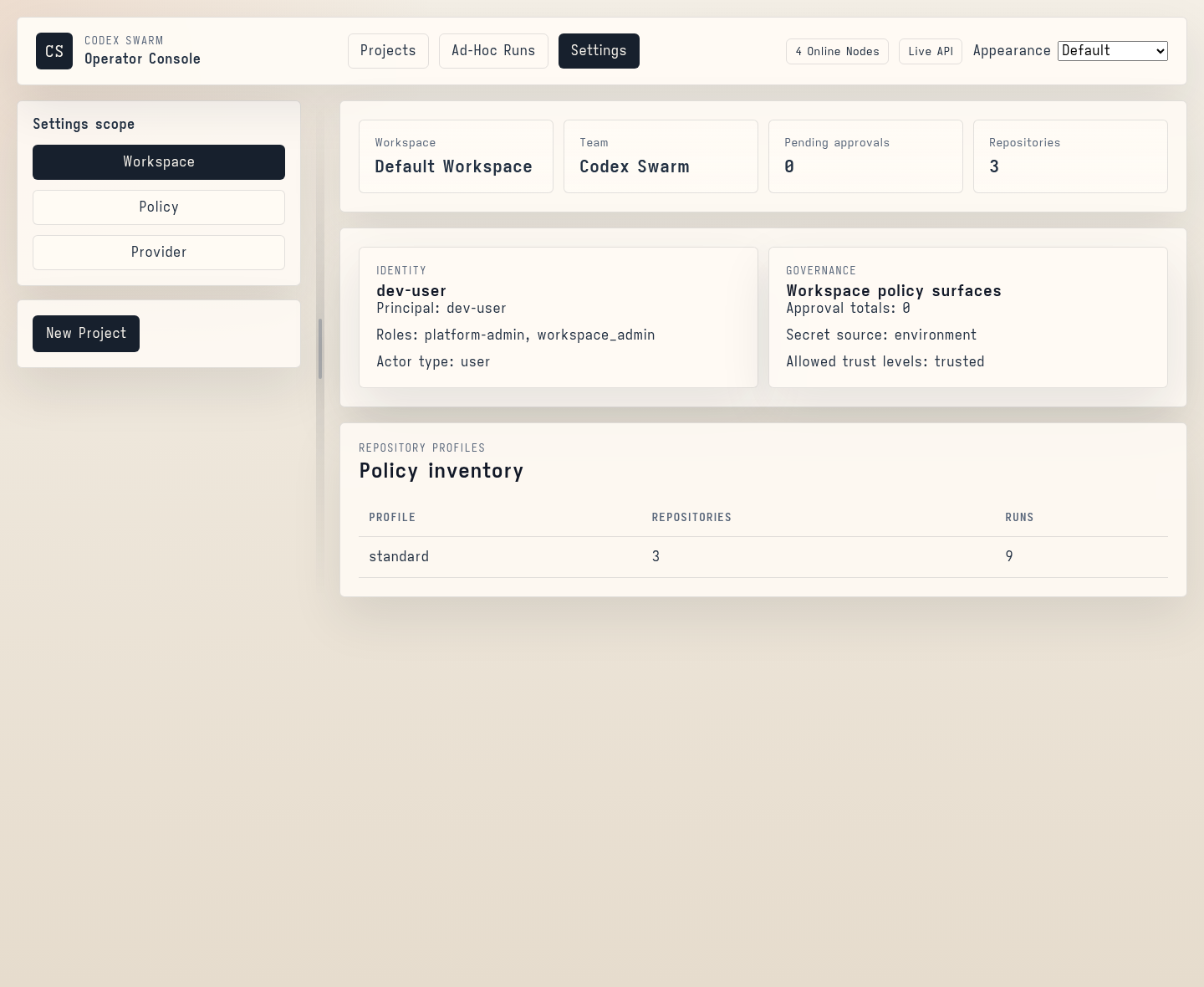
Repositories carry provider, trust, and policy metadata while runs, tasks, and handoff state stay anchored to delivery reality.
Supervised workers handle worktree provisioning, Codex session launch, validation execution, and recovery-aware placement.
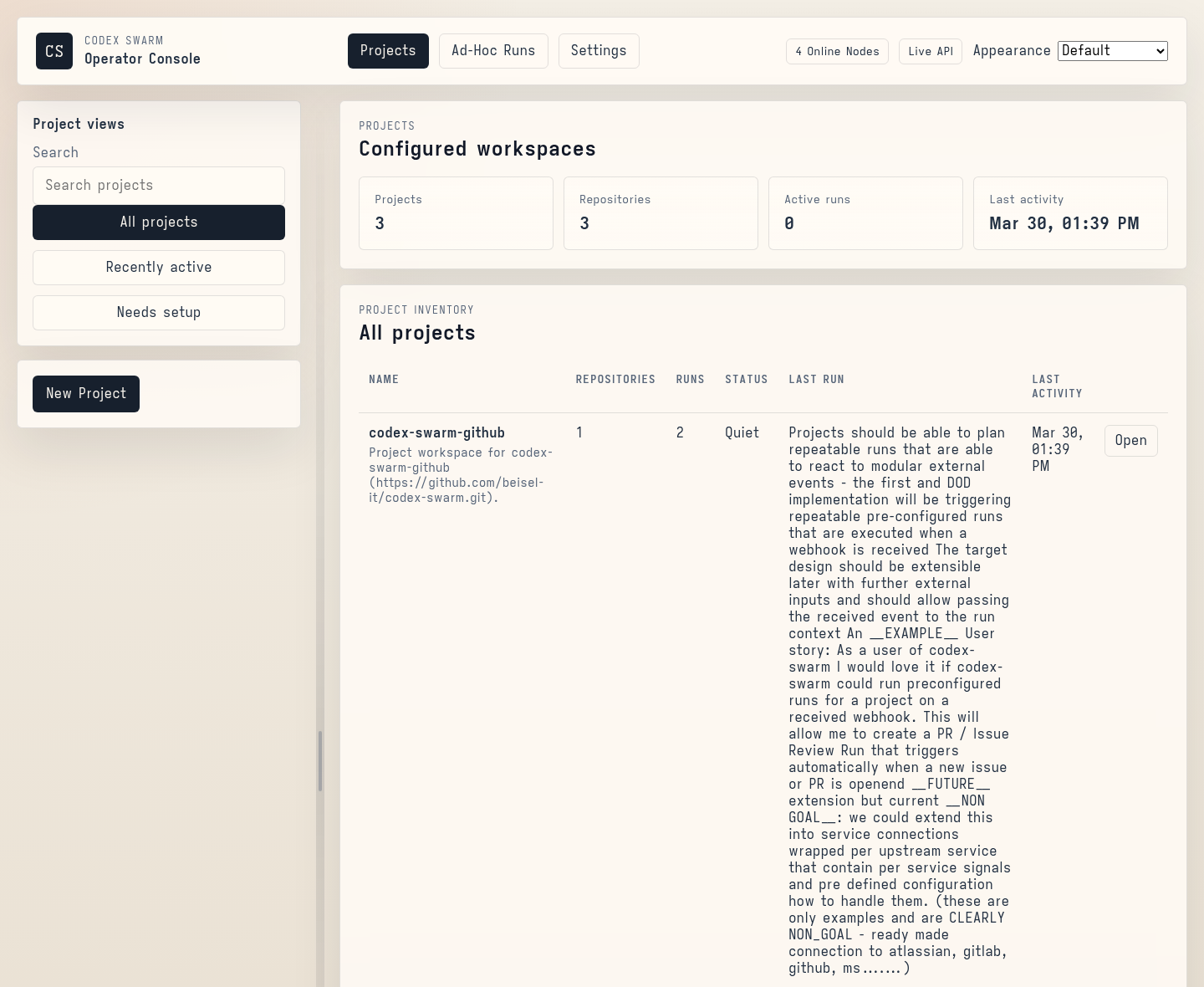
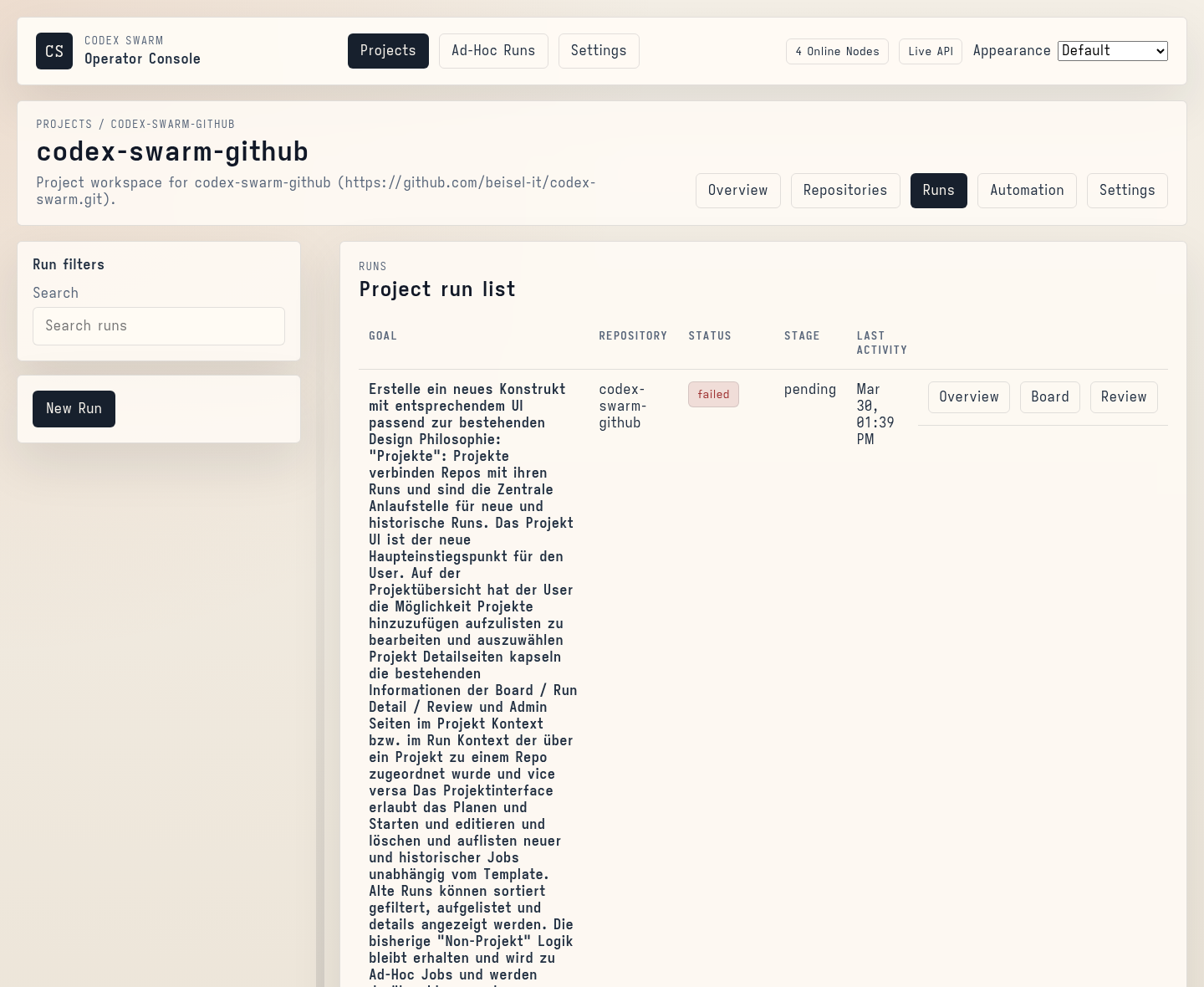
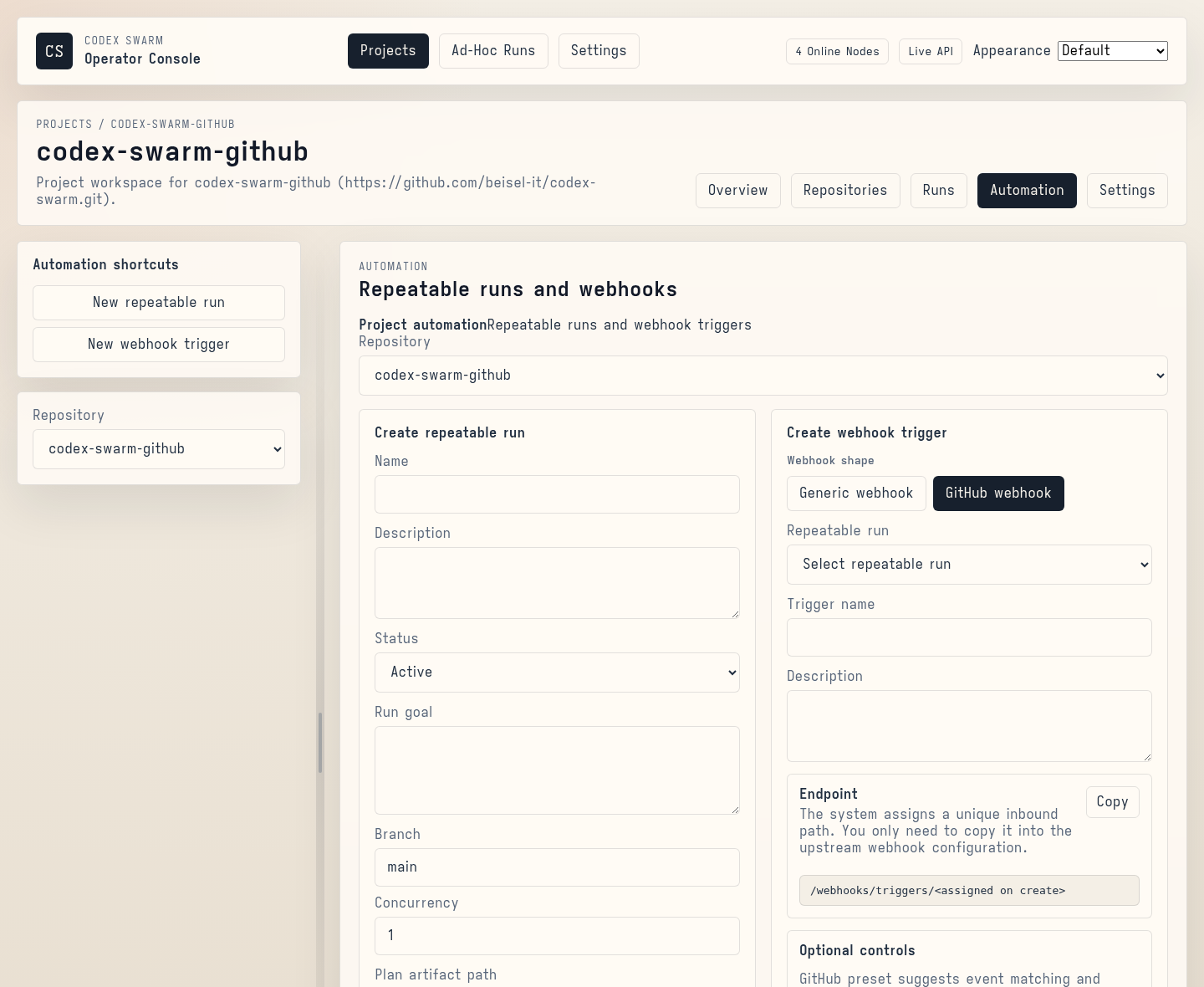
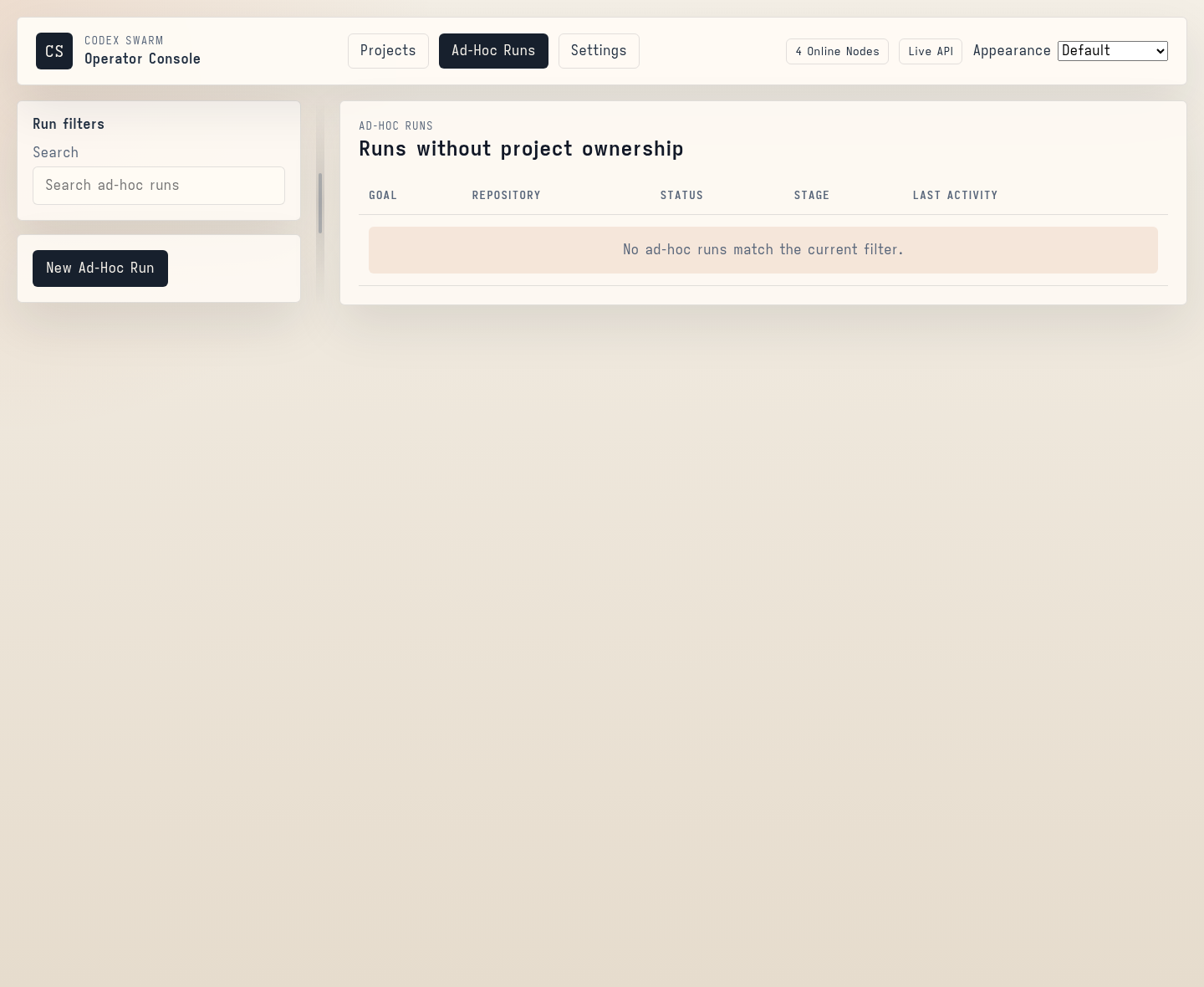
Browser surfaces cover projects, project runs, automation, run board, lifecycle, and settings while the TUI supports terminal-heavy operation.
Validation status, approval provenance, artifact retention, and audit exports remain visible throughout the operating loop.
Control Surface Signals
Product Surfaces
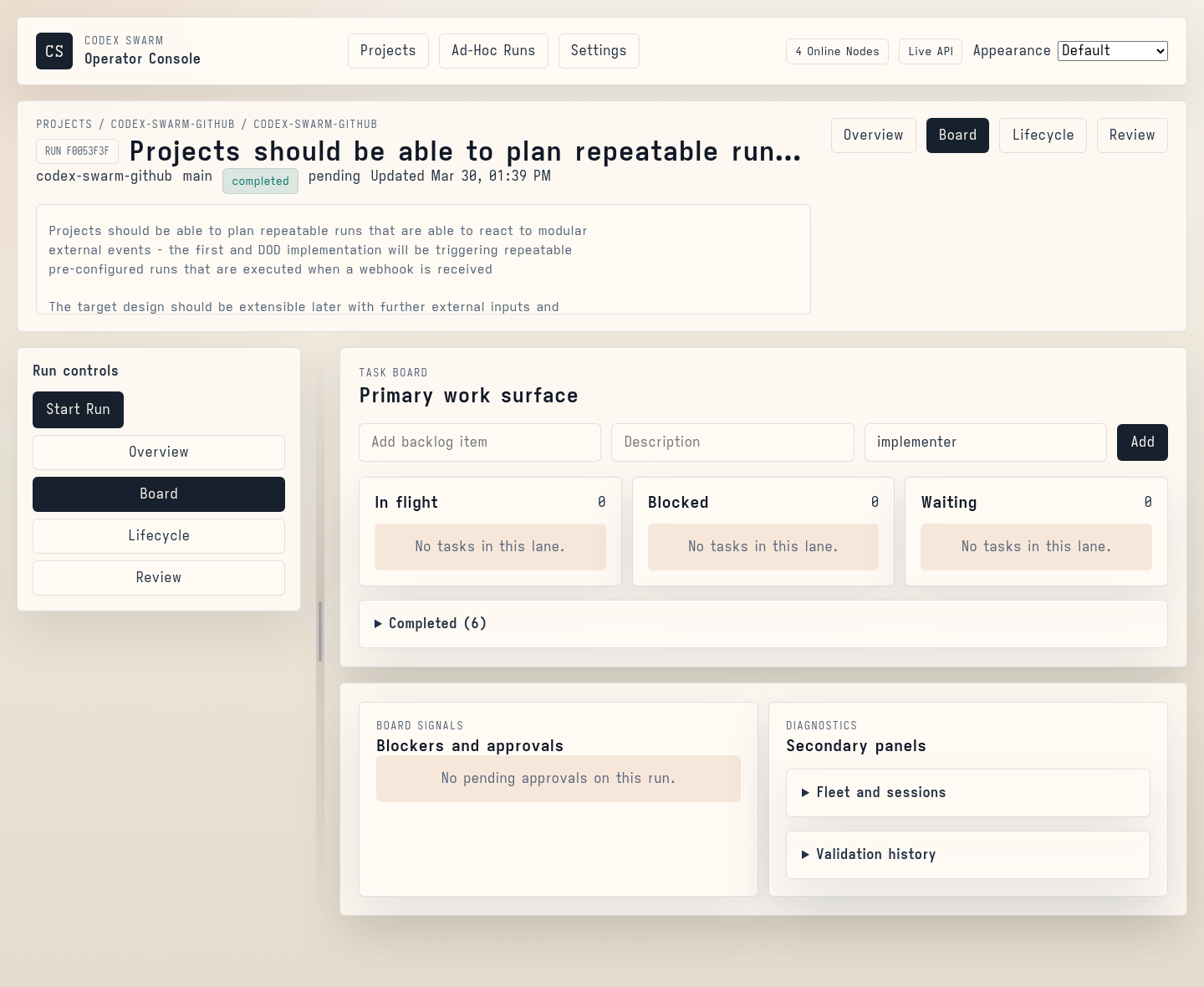
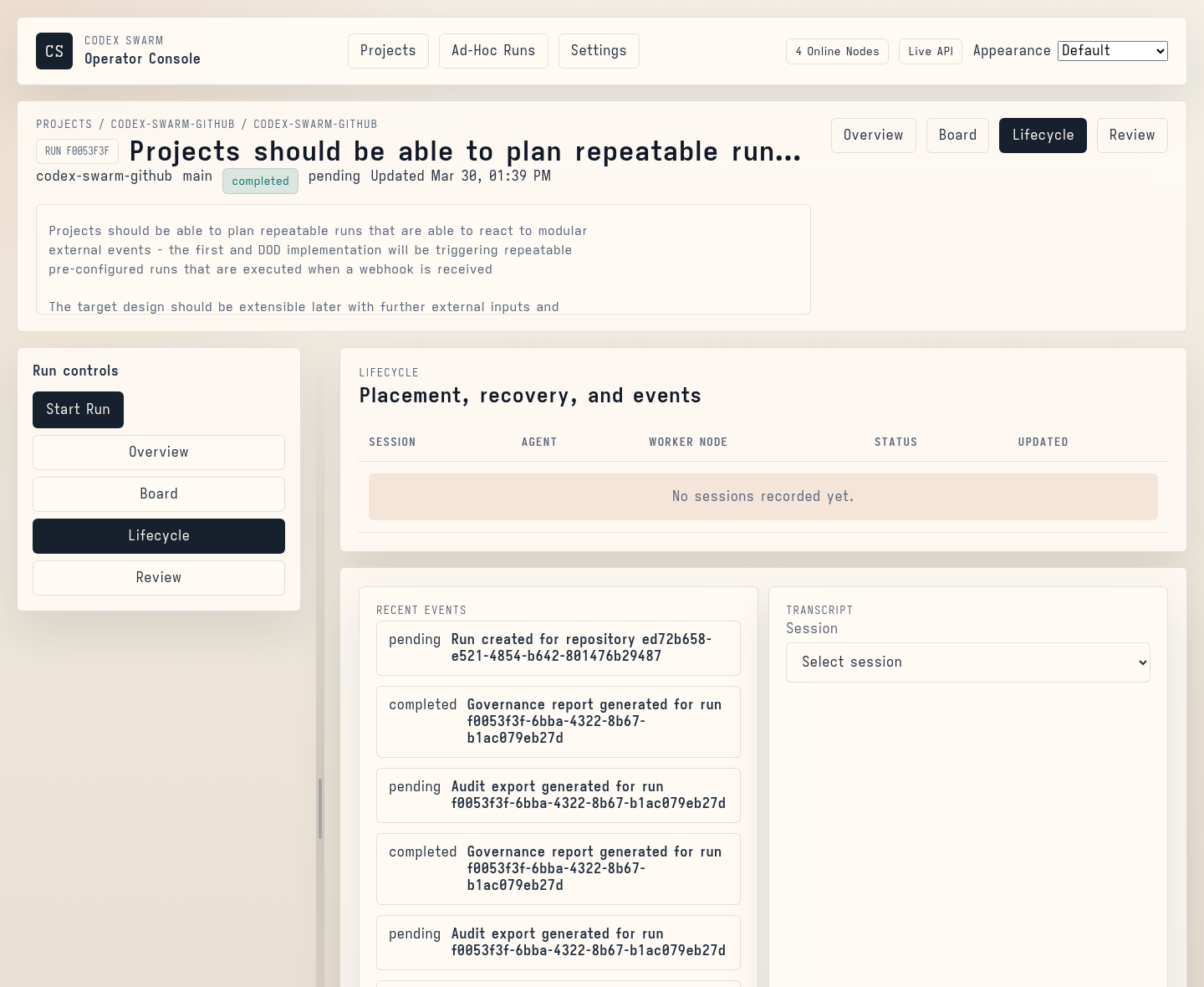
The repository already ships concrete browser surfaces, not just architecture diagrams. Run Board and Run Lifecycle are the deepest proofs because they expose active operation, diagnostics, and recovery context directly.
The board prioritizes task execution first, with blockers and diagnostics close enough to act on without losing flow.
Lifecycle centralizes placement, transcript context, recovery clues, and recent events when a slice needs intervention.
Technical Foundation
Codex Swarm is a working open source product with a modular repository layout, operator materials, and a concrete local bootstrap path.
Stack
Repo Shape
Quick Start
corepack pnpm install
cp .env.example .env
corepack pnpm dev:api
corepack pnpm dev:worker
corepack pnpm dev:frontend
Open Source Control Plane
Codex Swarm is already opinionated about repositories, runs, workers, evidence, and publish handoff. The fastest way to evaluate it is to inspect the repo, trace the operator journey, and read the product docs side by side.